
The Download »
AI Enters Fashion: Past, Present, Future
As AI reshapes the way clothes are imagined, produced, and consumed, the industry is forced to confront what it truly means to create
By Rupam Jain
Like at many moments in fashion history where the industry was forced to change — the moment the sewing machine speeded up the atelier, when ready- to-wear challenged couture, or when the internet turned runways into a global event — AI is currently creating such a seismic shift, though, in contrast to those aforementioned instances, it’s largely behind the screens and coded into systems, often beyond our recognition. As it steps into the fashion industry not as a spectacle, but as an ever-present participant, a profound and seemingly philosophical question looms: Can something programmed with data ever truly understand a discipline born of intuition? In an effort to answer this, we must first look to the roots of fashion.
The Past: When fashion was a feeling
The fast fashion we know and love today seems a world away from the fashion of yesteryear — slow, rhythmic, driven by the meticulous work of hands, and reliant on the transmission of skills not through the uploading of files but through the process of repetition. Shaped by a kind of knowledge that is only attainable through time, fashion used to be more about the inherent story of the garments — not just how they looked, but how they resonated. A dress that had been worn through generations, a coat passed from sibling to sibling, a certain weave or cut that was inextricably tied to the cultural identity of its origin — these details have a story that AI, programmed from raw data and lacking all emotional intelligence, can never comprehend.
With the idea of AI in fashion so prevalent today, and the undeniable notion that at its core, it’s based on pattern recognition rather than emotional comprehension, we feel a sense of slight dissonance at how we are to combine these disparate concepts. What would a human being possibly have to tell an algorithm about the concept of inheritance, tradition, nostalgia, or rebellion?
In reality, however, fashion has always borrowed from the past to inspire the future. Fashion archives, rediscovered historical clothing styles, and inspiration derived from a decade of dress — these are just a few of the ways that fashion historically influences design in the present. This is where AI begins to take on a more familiar aspect: the only difference, in reality, is the pace and the sheer scale of innovation, with the central conflict lying in what we feel and what we process.
The Present: Designing with the machine, not against it
One of the most exciting aspects of AI is not how it replaces designers, but how it augments and modifies the way in which they work. Alongside the sketchbook lies the screen, as ideas and visions are spurred not solely through observation or intuition, but through algorithms. Hillary Taymour, the designer of Collina Strada, was able to take her brand’s own archival designs, input them into a system with various prompts, and then interpret the images she received back — images that were oddly distorted or unnaturally styled. She describes these creations as being “off,” even “weird” — yet the point was precisely that they gave her a nudge outside her normal creative sphere.
A similar spirit fuels the designs presented by Paul Billot; his show, held at Fashion Week in Paris, showcased his use of the system not as a means to automate and fast-track his designs, but instead to produce something unexpected, and as he put it “innocently flawed.” The concept of “innocence” is what seems to define the way he chooses to use AI — rather than to enhance existing designs, he uses it as a device for creating novelty in fashion. Such trends, although unconventional, are being adapted more and more. The Fashion X AI Show displayed garments of startling and alien shapes and textures that truly challenged what is to be expected from design.
As Alayna Zaid, founder of Siorai, a modern luxury brand, puts it, “Fashion has always been built on hands — the hands of skilled artisans who spent lifetimes perfecting their craft, stitch by stitch, bead by bead. That human touch has never been negotiable. However, as AI enters the conversation, we see it not as a threat to that legacy, but as its most powerful protector yet. Where the past relied entirely on skilled hands to meticulously craft each piece, technology is now stepping in to support, document, and preserve those very techniques, ensuring nothing is lost between generations of makers.”
She adds, “Today, AI helps the industry work smarter alongside its artisans, enabling better material decisions, sharper production planning and less waste, which is very important given the state of the fashion industry today. And tomorrow? It will do what no archive ever could: keep the soul of handcraft alive, relevant and accessible, without ever replacing the hands that create it.”
Meanwhile, behemoths such as Tommy Hilfiger are using AI not for design creation, but for trend analysis. Their team of data specialists and AI programmers take into account aspects of previous collections which were successful — a colour, a pattern, a silhouette — and use the system to extrapolate how to achieve these trends in a fresh and marketable way, taking care to ensure that they are not just functional, but aesthetically engaging. Even in this seemingly objective use of AI, taste becomes the determining factor. It’s not just about what works statistically, but about what is intuitively compelling; an area where AI still cannot and may never compete with the human instinct for taste.

The industry shift: Faster, smarter, and slightly uneasy
There is no question that the use of AI will dramatically speed up fashion — sampling can be produced in seconds, inventory can be managed at a glance and retail experiences can become infinitely more responsive. But beyond the practical benefits of using AI, what are the human implications of this digital overhaul? When we’re able to generate endless images instantaneously, will the craft of image-making remain valued? And with the production of campaigns becoming an almost entirely digital process, where will those who traditionally work behind the scenes end up?
Although there is no definitive answer as to the long-term effects, what is certain is that fashion as we know it is changing
Beyond the physical: When fashion leaves the body
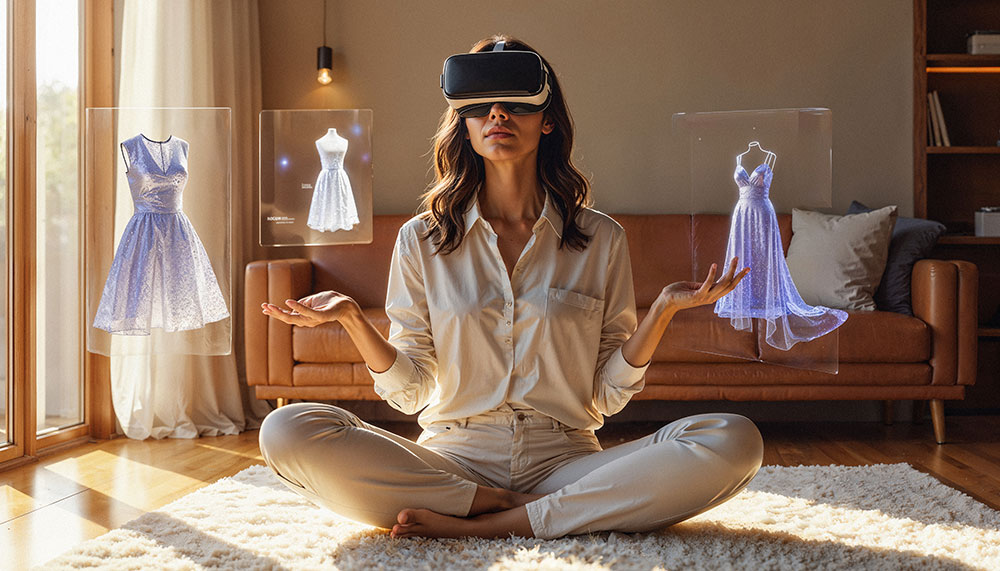
AI also has the power to truly revolutionize the concept of fashion beyond the limitations of the physical realm altogether. The Fabricant, a digital fashion house that produces garments for the digital fashion space and digital environments, creates pieces designed specifically for avatars, virtual reality, and online interaction — not for physical wear. While this may seem like a niche or far- fetched concept, when we consider the extent to which we all already inhabit online spaces and present ourselves through our profiles, this kind of fashion suddenly feels much less abstract. AI can be used in this context to remove all boundaries related to fabrication and physics; a garment can drape in ways that are impossible in reality, or a texture can shift and morph on command.
Fashion no longer needs to be constrained by the physical world, which has the potential to be both the downfall and the success of human-made garments; the limitations we’ve always lived by are slowly but surely diminishing.
The Future: When AI blurs into the background
For the moment, we are still at the initial stage of implementing AI within the fashion world, but the time is coming when it will cease to be the “thing”— the subject of articles and brand-focused marketing — and will become nothing more than an integrated function. Designers will continue to create; collections will continue to be showcased, but the systems and the infrastructure that support fashion production and design will be smarter, more responsive, and more intuitive. It is the notion of the human, the designer, that will still be central to the entire process. In a world where so many processes are automated and where instant gratification is the norm, the desire for well-made, handcrafted objects is likely only to increase, and this could also lead to an elevation in the value placed on both human and digital design.
“Craftsmanship has never needed saving. It has travelled across centuries because of the people who dedicate their lives to it, and because of the power of storytelling that carries its beauty across borders. Today, the world knows the name of Indian craft not by accident but because of the hands behind every piece and the voices that championed it. AI, in the present, gives us a stronger lens to understand our audience, make informed creative decisions and ensure our work reaches the people it is meant for. In the future, it will only deepen that connection, helping us communicate our rich cultural heritage with even greater precision and reach. But let us be clear: no algorithm replaces the artisan. What built this industry, and what keeps it at the centre of global conversation, is irreplaceable human craft. AI is simply here to make sure the world never stops hearing about it,” Mrunal Khimji, founder, Mrunal Khimji Label, points out.
As fashion evolves toward a more digital future, it will be the imperfections, rather than the perfect production process, that will give clothing its value.
“As AI enters the conversation, we see it not as a threat to that legacy, but as its most powerful protector yet.”
The question of taste
Of course, one of the biggest questions to come about as a result of such rapid development of technology and fashion is “taste” — a word which is notoriously difficult to define. Unlike logic and analytics, taste is not something that is easily quantified, it comes from a series of experiences, it is developed through exposure, it is based on something deeper than we can probably fathom.
AI can recognize preferences. AI can detect patterns. AI can even predict preferences. But taste is more than liking — taste requires selection, rejection, and interpretation. Taste requires judgment. And judgment remains, for now, a uniquely human affair.
Where it all ends up
It’s easy to talk about AI in fashion in terms of conflict: tradition vs technology, craftsmanship vs programming. This approach overlooks one key fact. This development isn’t about substitution — it’s about calibration. The designers have no intention of abandoning their role in the creative process. They want to incorporate AI, not replace themselves with it. It’s fascinating precisely because of this adaptation. The technology is nothing special — but the human reaction to it certainly is.
Fashion, as always, isn’t about technology. It’s about a point of view. It’s about how one sees the world and tries to articulate it with clothing. AI can change a lot in this process — it can accelerate it, facilitate it, enhance its results. But it won’t change the core idea behind fashion. That core idea — a complicated, instinctive, and emotional business — is still completely and undeniably human.