
The Download »
Sundar Pichai’s Cosmic AI!
5 AI updates Sundar Pichai recently dropped that you need to know
By Farhaan Tipu
Lately, the chief executive of Google has been on an overdrive, announcing some really ambitious projects in artificial intelligence that are right out of science fiction. The moves reportedly mark a shift in Silicon Valley, with reports indicating OpenAI has initiated a “code red” directive, moving all teams into urgent round-the-clock development mode to speed up upgrades to ChatGPT amid intensified pressure from Google’s newly released Gemini 3 model.
From data centers floating in space to AI agents doing your shopping, here is everything Sundar Pichai revealed in the last few months:
1. Data centers in space (yes, for real)
Perhaps most futuristic of all, Sundar Pichai announced that Google would begin constructing AI data centers in space starting in 2027, as part of Project Suncatcher. This initiative seeks to better harness solar energy by locating its data centers closer to the sun.
“We want to put these data centers in space, closer to the sun,” he said in a recent Fox News interview. He elaborated that the sun generates 100 trillion times more energy than what we create on Earth today.
Google will begin by launching small racks of machinery inside satellites to test the technology before scaling up. Sundar believes that, a decade hence, space-based data centers would be considered the normal way to build them out. First prototype satellites launch in partnership with Planet, a satellite imagery firm.

2. Gemini 3 Pro is here & it’s seriously smart
Just recently, Google released Gemini 3 Pro, and early results are suggesting this is a massive leap forward; the new model bests Gemini 2.5 Pro by over 50% in benchmark tests, with some of its biggest gains in coding and reasoning tasks.
Developers are already singing their praises. Many early users say that they see a big difference in code quality and problem-solving, and several call it a game-changer for dealing with difficult coding tasks. For the first time, there will be much better performance in complicated, multistep problems that have stumped AI assistants up until now.
Rollout is now happening in the Gemini app, with limits said to be higher still for Google AI Pro and Ultra subscribers. If you have been waiting for AI that can tackle truly complex problems, this might be the moment.

3. Deep Think mode can really think!
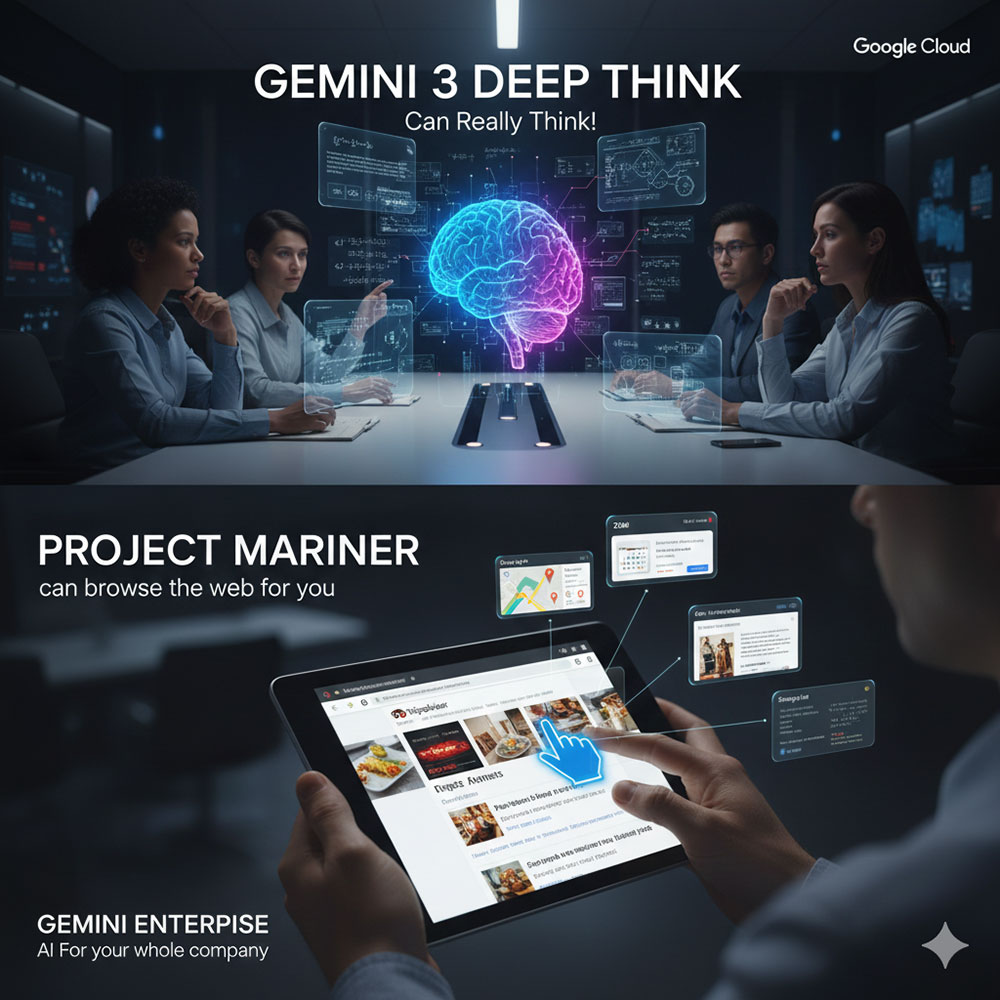
For subscribers to Google AI Ultra, there’s an even more powerful tool: Gemini 3 Deep Think. This advanced mode of reasoning employs multiple rounds of iterative thinking to explore different hypotheses at the same time, which makes it especially adept at solving math, science, and logic problems.
Unlike the quick response that is usually returned by the AI, Deep Think does take a few minutes to ponder over complex tasks. Users choose Deep Think on the prompt bar, submit their question, and Gemini lets them know when the response is ready. It’s for those problems where careful consideration brings better results than fast answers.
Equipped with creativity, strategic planning, and step-by-step improvement, the feature literally gives a powerful thinking partner to researchers and developers.
4. Gemini Enterprise: AI for your whole company
Last October, Sundar introduced Gemini Enterprise, aimed to drive AI capability for each employee in the organization. Unlike simple chatbots, this platform can integrate company data, tools, and applications into one secure system.
Early adopters like HCA Healthcare and Best Buy are seeing results. The platform allows employees to chat with the company’s data and build custom AI agents for certain workflows. With 65% of Google Cloud customers using AI products today, the enterprise push represents a bet that business transformation demands wide-ranging integration, not just standalone AI tools.
Google Cloud recently reached the $50 billion annual revenue run rate, with much of the growth triggered by AI adoption. Thirteen product lines now gross over $1 billion annually.

5. Project Mariner can browse the web for you
Perhaps the most immediately useful announcement, is Project Mariner, an experimental Chrome extension that can actually perform web-based tasks on your behalf. An AI agent will be able to traverse websites, add things to lists, and perform multi-step operations — say pulling top restaurants from Tripadvisor and adding them directly to Google Maps.
The updated version can multitask, accepting up to 10 requests simultaneously. It opens websites, adjusts filters for you, and even books your appointments. Looking at apartments on apps? Mariner searches the list, filters it against your criteria, and books tours for you. It just started rolling out to Gemini subscribers in the US. For businesses like Zillow or MagicBricks, it brings more users and better conversion rates. For end-users, it means outsourcing mundane online chores to AI.
The verdict
These announcements show Google going all-in on AI, from literal moonshots to practical everyday tools. Sundar has been clear about the stakes: “The opportunity with AI is as big as it gets,” he said at the AI Action Summit in Paris. Whether it’s data centers orbiting Earth or AI agents booking your travel, Google’s vision for the future is rapidly becoming a reality. And if Sundar’s timeline holds, we are just getting started.