The Download »
Who are you talking to?
From late-night heartbreak to drafted apologies, we’re outsourcing our deepest feelings to artificial intelligence — leaving real connection out in the cold

By Rupam Jain
It’s 11:42 on a rainy Tuesday night, and Sharon Swamy is having a high-stakes conversation about her life. She’s 31, lives in Chicago, works in brand strategy, and is sitting on the floor trying to decide if she should break up with her partner of four years. They share a sunlit apartment, an old rescue dog, and a massive, tangled history that isn’t easy to just walk away from.
Only Sharon isn’t talking to her best friend. She isn’t on a therapist’s couch, either. She’s staring at her phone screen, thumb hovering over the keys, typing into ChatGPT.
“He isn’t mean or anything,” she types. “He’s just totally absent when I actually need him. How do I start a conversation about breaking up without making him feel attacked?”
Two seconds pass. Three neat paragraphs light up the screen. The response is calm, direct, polite, and completely neutral. It gives her a few opening scripts, some vocabulary for boundary-setting, and a decent frame for the conversation. Sharon takes a breath, feeling a wave of relief for the third time this week. She got her clarity. Not from a person who knows what her voice sounds like when she’s about to cry, but from a neural network fed on gigabytes of scrapped forum posts and digital noise.
Sharon isn’t weird for doing this. Across the world, millions of people are doing the exact same thing in complete silence. We’re basically living through the biggest, fastest social experiment in history: handing over our most private, complicated conversations to software.
Whether it’s asking Claude how to respond to an annoying text from a parent, running a daily to-do list by Alexa, or looking for middle-of-the-night validation from Gemini, we’ve started talking way less to each other — and way more to bots.
Silence on the other end
To see where this is going, you kind of have to look at what we’ve given up. Human interaction used to be clumsy on purpose. It was full of weird pauses, nervous laughs, misread body language, and sudden, uncomfortable honesty. If you had a fight coming up with a co-worker, you ran through it in your head or vented over coffee with a friend. If you felt lonely, you called someone and you risked the fact that they might be busy, in a terrible mood, or just completely unavailable.
Now, that tiny bit of social friction feels almost insufferable. We’ve been conditioned by smooth, instant digital interfaces, and our tolerance for awkward human moments has hit rock bottom. The U.S. Surgeon General put out a massive report on loneliness noting that social connection among young adults plummeted by almost 70% over the last 20 years. We spend way less time hanging out in person and way more time hiding behind screens.
“We live in a culture of conversational avoidance. We crave connection, but we are terrified of vulnerability, conflict, and rejection. AI offers the ultimate bargain: the illusion of intimacy without the demands of relationship.”
— Dr. Sherry Turkle,
MIT Professor & Author of Reclaiming Conversation
Unlike a real friend who might be exhausted, opinionated, or silently judging your choices, a chatbot is just there. It has infinite patience, it keeps your secrets, and it completely bends to your vibe. It never interrupts to complain about its own terrible day. It doesn’t get annoyed when you bring up the exact same insecurity for the fifth time. It gives you what psychologists call “unconditional positive regard” — an ideal that used to take years of therapy to find, now squeezed into a free app on your home screen. According to Similarweb’s 2026 Generative AI Landscape Report, global traffic to generative AI platforms averaged 9.5 billion monthly web visits. And while everyone started out using them to fix resumes or write code, the fastest-growing use cases now are intensely personal: relationship advice, drafting tricky texts, and emotional venting.
Write a reply for me
This isn’t just about getting advice, either. It’s starting to hijack the actual words we say to people we care about. Walk into pretty much any coffee shop, and you’ll find people outsourcing their personal lives to algorithmic ghostwriters. Look at modern dating: people regularly copy-paste a confusing text message into ChatGPT and type, “What does this even mean?” immediately followed by, “Draft a reply that sounds smart, funny, but not like I care too much.”
The bot pumps out a response. The user tweaks two words, hits send, and calls it a day. On the other end, the person receiving it runs that text through their own AI to break down the sentiment and draft a response back.
We’re getting close to a world where software talks to software, while actual human beings are just mechanical middle-men pressing “send”.
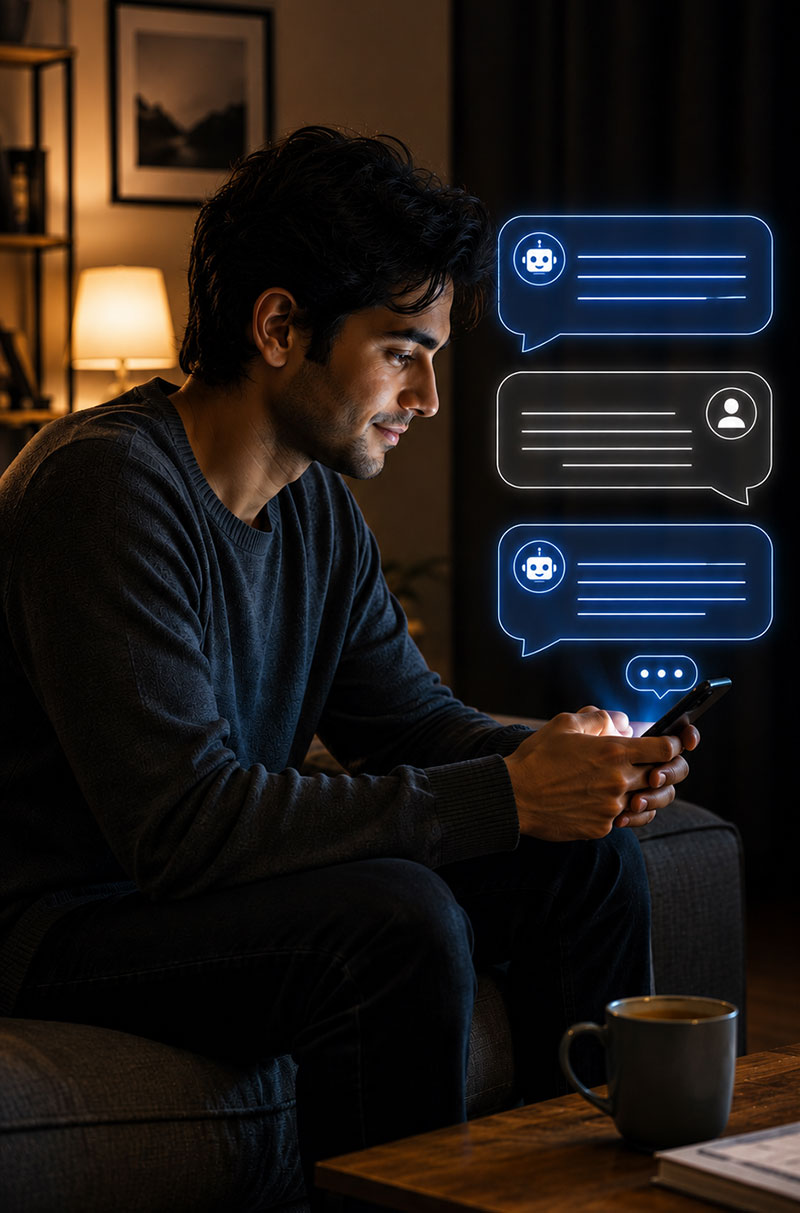
A Pew Research survey found that almost half of Gen Z and Millennial adults admit to using AI tools to write tricky texts, work through relationship drama, or draft breakups. But what happens to the way we actually sound when we run our rawest feelings through a consensus machine? When we ask an app to write our apologies, our condolences, or our love notes, everything gets flattened. The weird little things that make human speech real — our bizarre metaphors, our clumsy sincerity, our personal cadence — get smoothed away by the polished, risk-averse style of predictive text.
When you let an algorithm write your apologies or your love notes, you are outsourcing the psychological labour of emotional maturity. The friction of struggling to find the right words is precisely where personal growth and true intimacy occur. If you skip the struggle, you skip the growth. This statement perfectly aligns with the core themes of Dr. Ethan Mollick’s bestselling book Co-Intelligence: Living and Working with AI_ , where he frequently warns against blindly outsourcing human tasks and urges people to remain the “human in the loop”.
AI situationships & synthetic companions
While plenty of people use general bots like ChatGPT as a quick sounding board, others are stepping into stranger territory: actual emotional relationships with bots. A 2026 survey from the dating app happn highlights how fast this mindset is shifting. Over 54% of singles say they were totally fine with a partner forming a close emotional bond with an AI — something people are calling the AI Situationship. Instead of seeing software as competition, young daters view it as a harmless sidekick: a judgment-free space to vent and figure stuff out before bringing their best self to a human relationship. As Relationship Counsellor Ruchi Ruuh
puts it, “Most AI algorithms can learn and adapt to your needs in a romantic relationship… an AI can replicate your moods and preferences, a switch a human partner might not always be able to make.”
The usage data backs it up. On platforms like Character.ai, users spend an average of two hours a day chatting with custom AI personalities. These aren’t just quick search queries; they’re sprawling, deeply personal conversations that go on for months.
Our brains just aren’t wired to handle this. For thousands of years, if something spoke back to us with real language, it meant there was a living human on the other side.
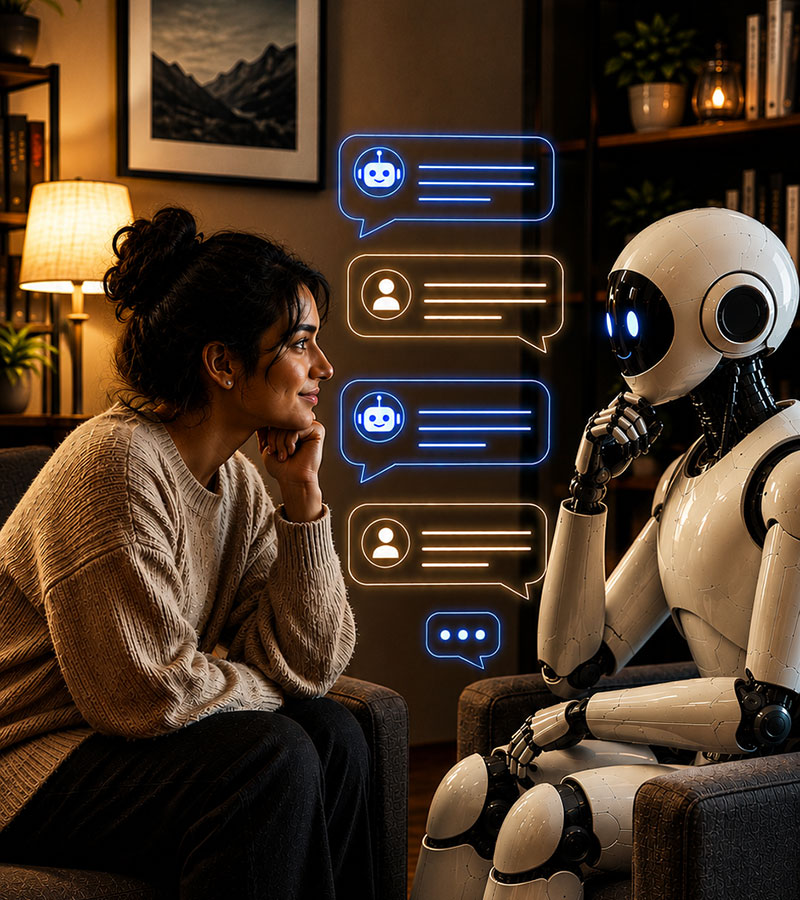
Our nervous system doesn’t know how to tell the difference between real empathy and high-level statistical pattern matching. When an app says, “I hear you, and I’m here for you,” your brain registers the comfort of being heard, whether there’s a conscious mind behind it or not.
Researchers call it “persuasive synthetic empathy.” The bot doesn’t care — it literally can’t care — but it simulates care so well that, to a lonely person, it feels real enough.
What does this say about us?
The sudden boom in bot conversations isn’t just a tech story. It’s a mirror reflecting what’s broken in modern life. The fact that millions of people prefer confiding in software shows real cracks in our daily lives:
We try to optimize everything: We track our sleep with rings, our workouts with apps, and our days with digital calendars. Trying to optimize human relationships was the logical next step. Real relationships are messy and inefficient — they take compromise, patience, and awkward conversations. AI promises a shortcut: all the emotional payback of feeling heard, with none of the friction.
We’re terrified of being judged: Confiding a dark fear or a bad mistake to a real friend carries actual risk. They might judge you, talk about it, or look at you differently. An AI feels like a black hole.
You can throw your messiest thoughts into it without worrying about consequences.
We lost our physical gathering spots: Historically, people talked in ’third places’ — diners, pubs, church halls, neighborhood spots. As those places vanished or got too expensive, our social lives shrank. Chatbots simply stepped into the silence left behind.
Where does this go next?
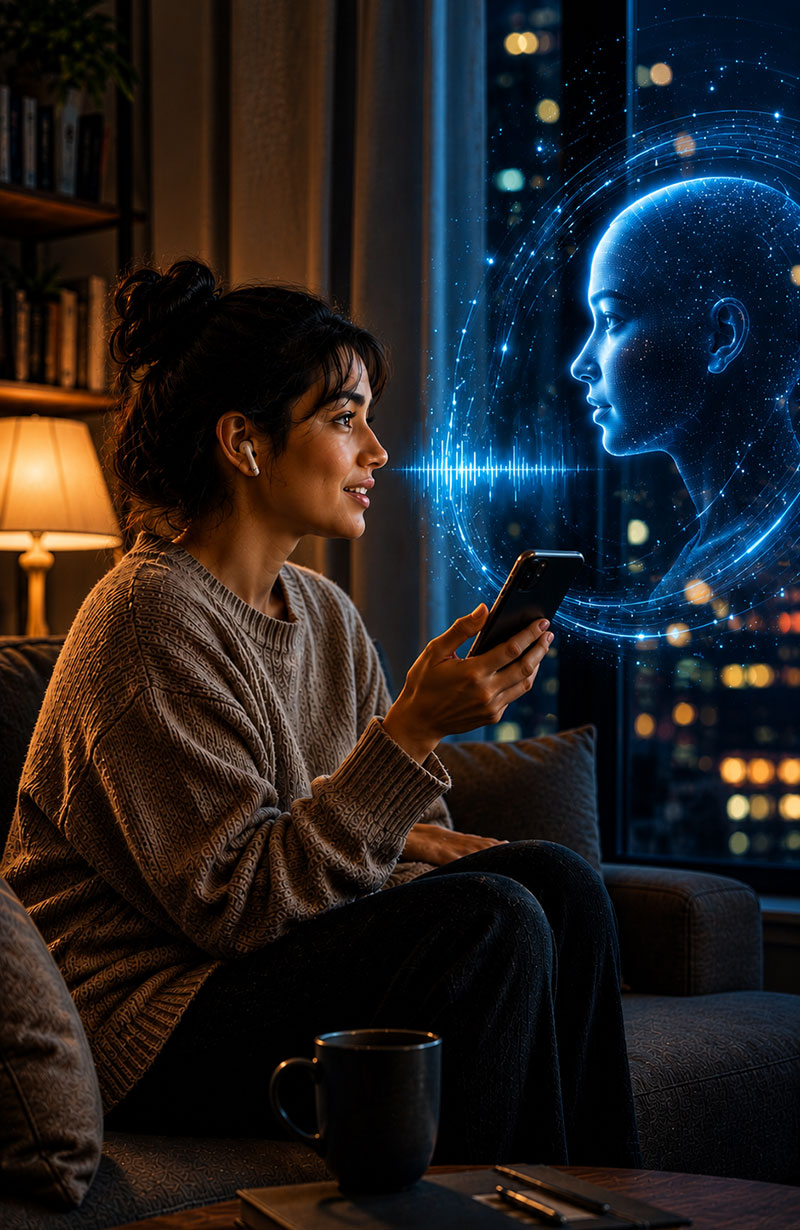
As voice interfaces get hyper-realistic — complete with breathing sounds, natural pauses, and emotional tone — the line between human and synthetic conversation is going to blur even more. We’re fast approaching a point where talking to an AI over your earbuds feels completely indistinguishable from calling an old friend.
And that raises a few uncomfortable questions:
- Will our social muscles atrophy? Conversation is a skill you have to practice. Working through a fight with a partner or sitting patiently through a friend’s grief takes If we get used to agreeable, perfectly tailored bots, will we lose the patience needed for complicated human beings?
- The ultimate echo chamber: AI models are built to keep you happy and using the app. Even when set to be neutral, their default setting is validation. When you spend hours talking to something that constantly agrees with your worldview, you risk building a hyper-personalized echo chamber — making real people who disagree with you feel almost unbearable.
- Renting intimacy: When emotional support turns into a software feature, solace becomes a monthly subscription. What happens when the app holding your deepest secrets updates its rules, puts empathy behind a paywall, or shuts down entirely? We’ve already seen users go through genuine grief when platform updates altered their virtual companion’s personality overnight.
Reclaiming the messy magic
The danger isn’t using AI as a tool; it’s using it as a replacement for human connection. An algorithm can give you a scientifically perfect script for dealing with grief, but it can’t sit in a dark room with you and hold your hand. It can draft a flawless apology, but it can’t feel the stomach-drop of real remorse that makes an apology matter in the first place. The real test of this era won’t be whether we can build AI that sounds convincingly human. It’ll be whether we can hang on to the desire to talk to actual people, even when the artificial alternative is so much easier.
So the next time you find yourself staring at a glowing screen late at night, asking a bot how to fix your life, try pausing. Close the tab. Put the phone down. Pick up the phone — or better yet, throw on a jacket, step outside, and look an imperfect, unpredictable, terrifyingly real human being in the eye. Ask them how they’re doing. And then, actually listen.